Starters
Socca
La socca
Socca is Nice's thin chickpea pancake, baked very hot until crisp at the edges and soft inside. The label recipe, adapted for a home oven.
Published
- Prep
- 10 min
- Cook
- 40 min
- Rest
- 2 h
- Total
- 2 h 50 min
- Serves
- 4
- Difficulty
- Easy
Method
Pour the cold water into a bowl, add the chickpea flour, the 4 tablespoons of olive oil and the salt, and whisk hard until there are no lumps.
Pass the batter through a fine sieve. Cover and leave it to rest for at least 2 hours at room temperature, or overnight in the fridge.
Whisk again. The batter should be as thin as single cream; if it is thicker, whisk in a little water.
Put the oven rack in the highest position and heat the oven to its maximum with the grill (broiler) on. Put a 30 cm (12 in) metal pizza pan or cast-iron pan inside to heat for 5 minutes.
Take out the hot pan, brush it with a thin film of olive oil and pour in a ladle of batter (about 180 ml), tilting the pan so it forms a layer 2 to 3 mm thick.
Bake on the top rack for about 5 minutes, turn the pan around and bake 3 to 5 minutes more, until the surface is golden with dark blistered spots and the edges are crisp.
Slide the socca onto a board, tear or cut it into rough pieces, grind plenty of pepper over it and eat at once. Repeat with the rest of the batter.
Tips
- Do not skip the rest. The flour needs time to absorb the water, and rested batter crisps better.
- The pan must be very hot before the batter goes in. If the batter does not sizzle, give the pan more time.
- A few dark, charred spots are part of good socca. A pale socca was baked too cool or too thick.
- No grill, or a weak oven? Cook it in a frying pan instead (see below).
Watch it being made

Comment Faire La Socca : Une recette traditionnelle Niçoise — La méthode Cuisinier (YouTube). The player loads only when you press play.
Socca, Nice’s chickpea street food
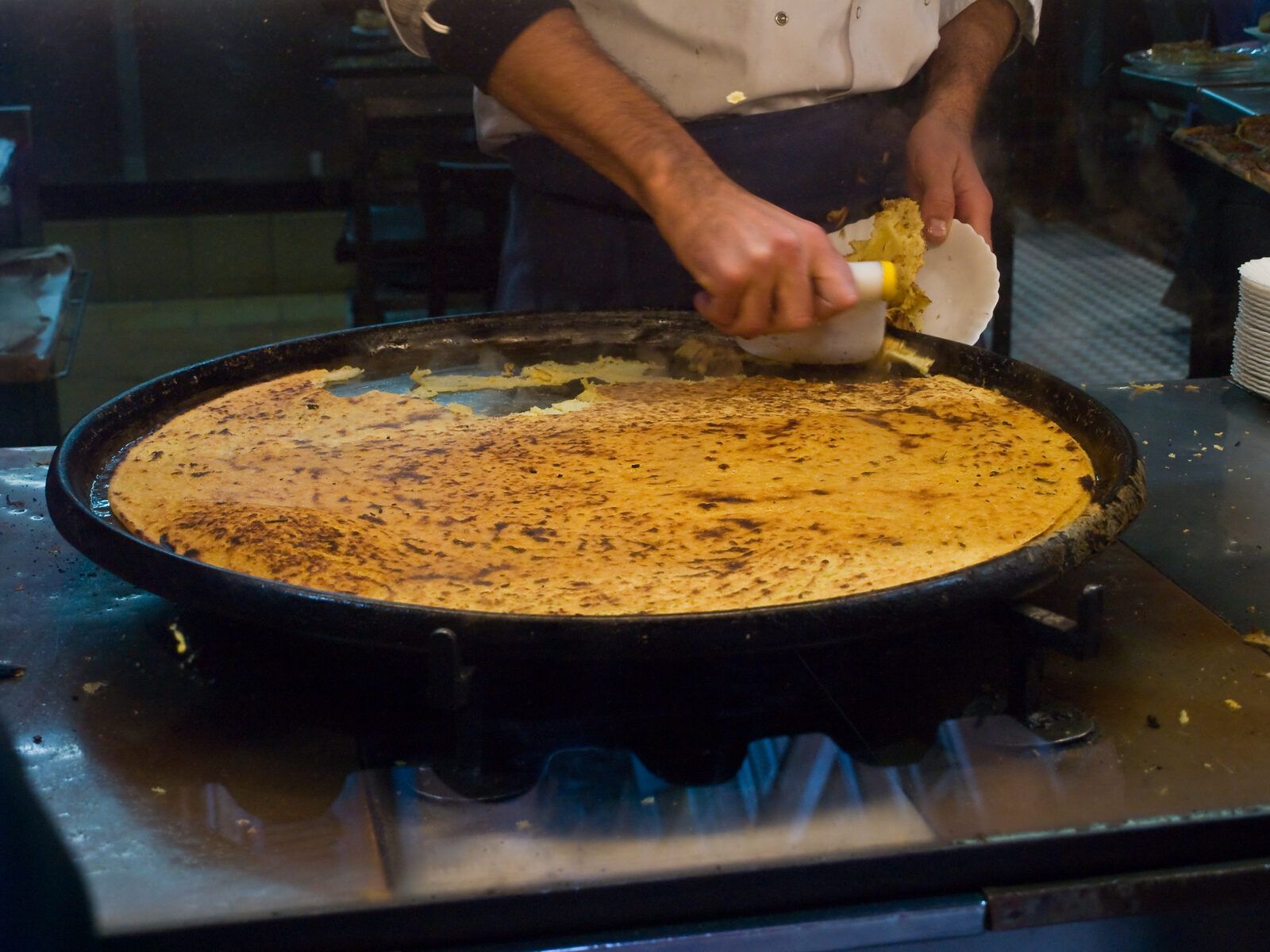
Socca is a large, very thin pancake of chickpea flour, water, olive oil and salt, baked on a round metal plate in a very hot oven. In Nice it is sold by the piece, peppered, and eaten with the fingers while still hot. The edges turn crisp and slightly charred; the middle stays soft.
The Cuisine Nissarde label, which the Nice Côte d’Azur tourist office awards to restaurants serving genuine Niçoise dishes, publishes the reference recipe: 250 g of chickpea flour to half a litre of water, a rest of at least two hours, a layer of batter only 2 to 3 mm thick on a 50 cm copper plate, and an oven of at least 280 °C. Its one serving rule is that socca is eaten the moment it leaves the oven. Socca sits with pissaladière among the everyday street foods of Nice, described in our guide to Niçoise cooking.
How cooks in Nice make socca
The recipe barely changes from cook to cook. The heat, the oil and the plate do.
| Version | Heat | Oil on the plate | Batter |
|---|---|---|---|
| Cuisine Nissarde label | Wood-fired oven, at least 280 °C | Generous | 250 g flour, 500 ml water, rested 2 h or more |
| David Faure, Nice chef (2014) | Wood oven heated for 4 to 5 hours, flames over the top | One or two drops | Poured from a bottle, shaken well |
| D’AQUÌ, Nice channel (2022) | Home oven, grill and both elements at maximum, top shelf | Thin film | About 200 g flour to 500 ml water |
| La méthode Cuisinier (2023) | Embers, or a frying pan on the hob | Generous in the pan | 200 g flour, 300 ml water, rested 30 min to overnight |
In Faure’s video the plate goes into an oven that has burned for hours. He turns it regularly and feeds the fire so the flames lick the surface, which gives the colour and the crunch. He pours the batter from a bottle rather than with a ladle, which is faster, and uses almost no oil on the plate, because too much makes socca greasy. He finishes with pepper and a little salt. He tears it into uneven pieces rather than cutting neat slices.
Making socca in a home oven
A home oven does not reach the heat of a wood-fired oven, so the trick is to bring the pan as close as possible to the top heat source. The Niçois channel D’AQUÌ puts a crêpe pan on the highest shelf, under the grill, with every element at maximum, bakes for five minutes, turns the pan and bakes five minutes more. Our steps above follow that method with the label’s quantities.
A 30 cm pan holds about 180 ml of batter at the right thickness, so the recipe makes four socca. Thin metal pizza pans and cast iron both work; a thick ceramic dish does not get hot enough. If you pass through Nice, La méthode Cuisinier suggests buying the traditional tinned copper plate there.
Socca in a frying pan
Without a grill, cook socca on the hob. Heat a large frying pan until very hot, add a good spoonful of olive oil and pour in two small ladles of batter, swirling to cover the base. Leave it until the underside is golden and the socca releases from the pan on its own, then flip it and crisp the second side. La méthode Cuisinier shows this method next to the wood-fired one. The result is thicker and less blistered than oven socca, but crisp on both sides.
Socca, farinata and cade
The same batter is cooked along the coast under other names. In Liguria it is farinata, sometimes topped with onions or rosemary. Toulon has cade, which France 3 called the cousin of Nice socca and of Marseille’s panisses, chickpea fritters. In Nice, socca stays plain: chickpea, olive oil, salt and a lot of black pepper.
Serving socca
Serve socca as soon as it is out of the oven, on a board in the middle of the table, as an apéritif or a light lunch with a salade niçoise. A glass of chilled rosé or white wine suits its salt and pepper. Bake one socca at a time while people eat: it loses its crunch within minutes.
Questions & answers
Is socca gluten-free?
Chickpea flour contains no gluten, so socca made only with chickpea flour, water, olive oil and salt is naturally gluten-free. If you avoid gluten strictly, check that the flour is certified gluten-free, because some is milled alongside wheat.
Can I make socca ahead and reheat it?
Socca is at its best straight out of the oven, which is how Nice eats it. You can rest the batter a day ahead in the fridge, but bake each socca just before serving.
Where does the name socca come from?
Socca is the dish's name in Niçois. The same chickpea batter is called farinata in Liguria, across the Italian border.
Sources